

Top Risk Factors for Bladder Cancer You Should Know
February 11th, 2026 by Fuad Elkhoury

First, a person notices blood in their urine. This is frightening. The patient goes to the doctor, and one likely explanation for hematuria is bladder cancer. Blood in the urine is detected in 80–90% of patients with this disease, and it may be the only symptom in the early stages. A person may also experience a frequent urge to urinate, a burning sensation when urinating, pain in the lower abdomen or lower back, and a feeling of incomplete urination. Don’t panic ahead of time. These symptoms can also indicate another disease. So the first thing a person should do is see a doctor. Let’s talk about bladder cancer symptoms, which, if noticed, should not be delayed!
Bladder Cancer Risk Factors
In 2022, an estimated 744,039 people were living with bladder cancer in the United States. Let’s talk about the risk factors that contribute to the development of the disease. Different types of cancer have different risk factors. Some risk factors are entirely modifiable. For example, the first step is to quit smoking. Unfortunately, heredity and age are also risk factors. If your relatives have had this disease, be especially attentive to your health. It’s important to clarify! The presence of a risk factor, or even several factors, does not necessarily mean you will get the disease. Some people seem to have a large list of risk factors, but the disease bypasses them. Others develop the disease even without a family history, not smoking, and so on. Still, it’s important to be aware of these factors. Then you can take care of your health and minimize your risk of developing the disease. Let’s talk about the main causes of bladder cancer.
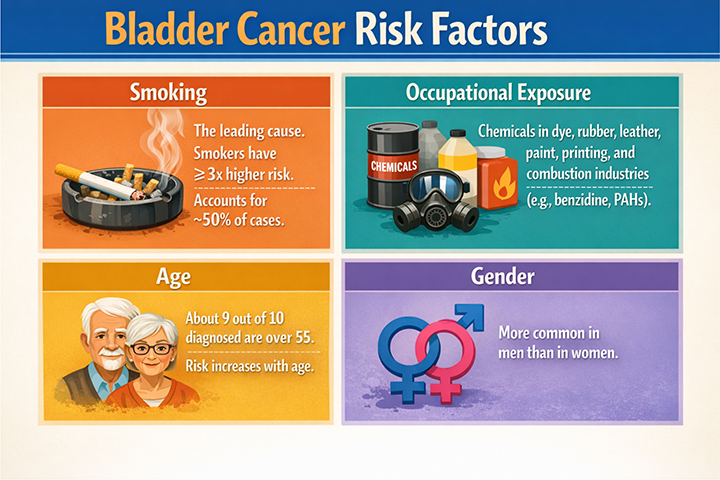
Smoking
Doctors consider smoking to be the leading risk factor for bladder cancer. Smokers are at least three times more likely to develop this disease than non-smokers. Smoking causes approximately half of all bladder cancer cases!
Those most at risk are those who:
- smoke for a long time
- smoke heavily
- smoke cigars and pipes
- started smoking at a young age and continued smoking for a long time
How does it work? Chemicals in smoke enter the bloodstream. They are then filtered from the blood by the kidneys and excreted in the urine. Urine is stored in the bladder. During this time, these chemicals come into contact with the bladder lining. Arylamine chemicals in cigarette smoke may be the cause of increased risk.
Occupational Exposure
Certain industrial chemicals can trigger the development of this disease.
Benzidine and beta-naphthylamine, which are sometimes used in the dyeing industry, are extremely dangerous. Workers in rubber, leather, textile, and paint manufacturing, as well as printing companies, may also be at higher risk of developing this dangerous condition.
Machinists, printers, painters, firefighters, and hairdressers who handle paint, as well as truck drivers who are exposed to diesel exhaust, should also be especially careful. Polycyclic aromatic hydrocarbons (PAHs) may increase the risk of bladder cancer. Those at risk include people who work with carbon or crude oil, as well as in any combustion-related industry, such as smelting. These two factors significantly combined increase the risk of bladder cancer. For example, if you work in such an industry and smoke, you are at increased risk.
Obesity
Some researchers have shown that obesity may increase the risk of bladder cancer, but the exact cause is still unknown.
Insufficient fluid intake
If you drink plenty of fluids every day, you generally have a much lower risk of developing this disease. You empty your bladder more often, which prevents the buildup of chemicals.
Male gender
Bladder cancer is more common in men than in women.
Certain medications or herbal supplements
Some dietary supplements contain aristolochic acid. Herbs of the Aristolochia family are especially rich in it. Unfortunately, scientists have documented a link between aristolochic acid and an increased risk of urothelial cancer, including bladder cancer. The diabetes drug pioglitazone, according to some experts, may be associated with an increased risk of bladder cancer. This doesn’t mean you should avoid the medication altogether, but you should be highly cautious with high doses.
Older age
Approximately 9 out of 10 people with bladder cancer are over 55 years old. The risk of bladder cancer increases with age.
Chronic bladder irritation and infections
Kidney stones and bladder stones, various urinary tract infections, prolonged use of urinary catheters, and other causes of chronic bladder irritation are indirectly associated by doctors with bladder cancer. This connection is particularly relevant for squamous cell bladder cancer. Schistosomiasis is an infection caused by a parasitic worm that can invade the bladder, significantly increasing the risk of developing the disease. Unfortunately, this parasite is prevalent in Africa and the Middle East, so people there are at a higher risk of developing squamous cell bladder cancer. This infection is an infrequent cause of bladder cancer in the United States.
Congenital Bladder Defects
The congenital defect of exstrophy significantly increases the risk of bladder cancer. The bladder and the abdominal wall in front of it do not close completely during fetal development and fuse. As a result, the inner lining of the bladder remains exposed to external influences. Surgery soon after birth can close the bladder and abdominal wall. However, unfortunately, people with this defect still have an increased risk of urinary tract infections and bladder cancer.
Before birth, there is a connection between the belly button and the bladder, called the urachus. If part of this connection remains after birth, it can develop into cancer. Such cancers are usually adenocarcinomas, which are composed of cancerous glandular cells. However, this is extremely rare, accounting for less than 1% of all bladder cancers.
Personal History
Urothelial carcinomas can sometimes occur in different areas of the bladder. They can also develop in the lining of the kidneys, ureters, and urethra. The presence of cancer in the lining of any part of the urinary tract increases the risk of developing another cancer, either in the exact location or in another part of the urinary tract. People who have had bladder cancer or other urothelial cancers should be carefully monitored.
Chemotherapy or radiation therapy
Long-term use of the chemotherapy drug cyclophosphamide can irritate the bladder, which may increase the risk of bladder cancer. Doctors often recommend that patients taking this drug drink plenty of fluids to protect the bladder from irritation. People who receive radiation therapy to the pelvis for other types of cancer are more likely to develop bladder cancer.
Genetics and Family History
If someone in your family has had bladder cancer, be especially attentive to your health and see a doctor regularly for checkups. Sometimes this family history is due to exposure to the same carcinogens. For example, such substances are found in tobacco smoke; if someone in the family smokes, everyone else inhales the smoke as well. Family members may also share common changes in specific genes (for example, GSTM1 and NAT2), which interfere with the body’s ability to break down certain toxins. This, in turn, can increase the risk of developing bladder cancer.
A small number of people inherit a gene mutation that causes a syndrome. Cowden disease is primarily associated with breast and thyroid cancer. People with this disease also have an increased risk of developing bladder cancer. A mutation in the retinoblastoma gene can cause eye cancer in infants and also increases the risk of bladder cancer. Lynch syndrome is primarily associated with colon and endometrial cancer. However, people with this syndrome may also have an increased risk of bladder cancer.
Race and Ethnicity
Scientists do not yet know the reason for these differences. However, it is known that white people are approximately twice as likely to develop bladder cancer as African Americans and Hispanics. Asian Americans have a slightly lower incidence of bladder cancer.
Arsenic in Drinking Water
Unfortunately, arsenic has been found in drinking water in some regions of the world. For most Americans, drinking water is not the primary source of arsenic.
Bladder Cancer Treatments
A doctor determines bladder cancer treatment options after examining the patient’s condition, medical history, and other factors. The doctor will determine the type of cancer, its grade and stage, and analyze the patient’s overall health and treatment preferences.
Treatment for bladder cancer may likely include:
- Surgery to remove cancer cells
- Radiation therapy to destroy cancer cells, often as the primary treatment when surgery is not possible or desirable
- Chemotherapy for the bladder
- Whole-body chemotherapy to improve the chances of cure in a person who has undergone bladder removal surgery, or as the primary treatment when surgery is not possible
- Immunotherapy to activate the body’s immune system to fight cancer cells
- Targeted therapy to treat advanced cancer when other treatments have failed
Each case is individual. The key is to seek medical attention promptly.
Conclusion
If you’ve just noticed signs of bladder cancer, you should see a doctor immediately. Choose a clinic you can trust. At Orange County Urology Associates, our team of board-certified urologists provides cutting-edge diagnostic technologies, personalized risk assessments, and comprehensive care. We use the latest techniques to relieve patients’ discomfort and help them regain their health. Trust your health to the experts. We look forward to seeing you!

Fuad Elkhoury
Los Angeles native Dr. Fuad Elkhoury, a skilled urologist, specializes in advanced endoscopic and robotic surgery. With expertise in kidney stone treatment and Holmium Laser Enucleation of the Prostate (HoLEP) for BPH, he prioritizes patient care, providing education and collaborative decision-making. A member of the American Urological Association, Dr. Elkhoury ensures a supportive experience, aiming to alleviate patient anxiety. Outside of his practice, he enjoys sports, outdoor activities, and family time.
Areas of Expertise: Advanced Endoscopic Surgery, Robotic Surgery, Holmium Laser Enucleation of the Prostate (HoLEP), Patient-Centric Care


- August 2026
- June 2026
- May 2026
- April 2026
- March 2026
- February 2026
- January 2026
- December 2025
- November 2025
- October 2025
- September 2025
- August 2025
- July 2025
- June 2025
- May 2025
- April 2025
- March 2025
- February 2025
- December 2024
- November 2024
- October 2024
- September 2024
- August 2024
- July 2024
- June 2024
- September 2020
- October 2018
- December 2017
- January 2017
- August 2016
- January 2016
- April 2015
- January 2014
- April 2013
- March 2013
- February 2013
- January 2013
- June 2012
- May 2012
- February 2012
- January 2012
- March 2011
- January 2011


